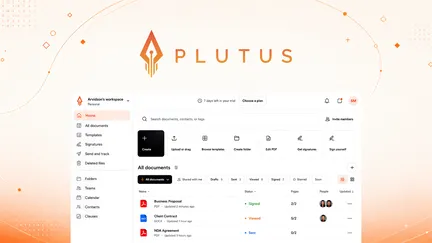
PlutusDoc
Automate document workflows with AI agents and track every open, signature, and stall in one place
Overview
PlutusDoc presents itself as a document workspace built around autonomous agents and a tightly governed action layer. Rather than treating AI as a sidebar assistant, the product exposes a single registry of nineteen discrete actions (draft, fill placeholders, add signers, send, remind, summarize activity, etc.) that both humans and agents can invoke. Agents run within a governed environment: they can perform many tasks but must stop for explicit human approval on critical actions. The product blends traditional e-signature features (templates, clause library, drag-and-drop fields, PDF handling, audit trails) with agent-driven automation, real-time document analytics, contact management, and meeting scheduling.
TL;DR
- Core differentiator: agent-first design where agents execute defined actions under approval gates and appear in the same audit trail as humans.
- Strong developer surface: REST API, webhooks, and an MCP (agent) endpoint for connecting external LLM clients and custom agents.
- Built-in workflow features: placeholder autofill, signature fields, open/time-on-page tracking, reminders, and analytics that diagnose stalled deals.
- Useful for freelancers, real estate, sales teams, and anyone who needs to automate and monitor contract flows.
Key features
Agent-Operated Action Registry
PlutusDoc’s fundamental concept is a registry of nineteen governed actions that cover document creation, reminders, analytics, contacts, and calendar operations. Agents like "Plutus" can run any of these actions, and the same actions are available to external MCP clients. Crucially, seven of the nineteen actions (including create, send, and remind) require human approval to complete, which balances automation with control.
Document Drafting and Template System
Documents can be created from templates, prompts, or uploaded files. Placeholders auto-fill from recipient data so one draft can serve multiple deals. There’s a clause library and about forty templates to speed repetitive work. Drag-and-drop signature and field placement is supported, and the final signed PDFs have flattened signature fields so the signed output is fixed.
Tracking, Analytics, and Reminders
Real-time tracking reports opens, time-on-page, and downloads per recipient from a single dashboard. The platform provides AI-generated activity summaries and diagnostic explanations for stalled documents, helping you pinpoint where a deal went quiet. Automated reminders can be scheduled and are subject to the same approval gates when initiated by agents.
Contacts and CRM-lite Capabilities
Contacts are unified with full document histories, reducing duplicate data entry. PlutusDoc includes suggestions for next steps based on activity. Contacts can be imported from Google, and contact records are available to reuse across drafts and sends.
Meetings and Scheduling Integration
The workspace includes a booking page and availability sync so clients can schedule meetings without back-and-forth. Meeting links are generated automatically, reschedules are handled in-product, and upcoming meetings display alongside active documents for context.
Integrations and developer tooling
API, Webhooks, and MCP
Developers get a standard REST API and webhooks that cover the document lifecycle (.created, .sent, .viewed, .signed, .completed, .declined, .voided). An MCP server endpoint enables direct connections from external LLM clients (e.g., Claude, ChatGPT-style agents, Copilot, Gemini) using OAuth 2.1, with least-privilege scopes by default. This architecture makes it straightforward to embed document actions inside other systems or let external agents orchestrate workflows.
Security, Authentication, and Governance
Connections use OAuth 2.1 with scoped grants; read scopes are default and write scopes are requested only when required. All connections and API keys can be viewed and revoked. Every action—whether human or agent—lands in a single audit trail that records time, IP, and device. Developer safeguards include idempotency keys for write requests to prevent duplicate sends and webhooks to observe true state changes rather than relying on guesswork.
UX and workflow observations
The UX is designed to let agents do the heavy lifting while keeping humans in control at crucial junctures. For teams that send many similar documents, the placeholder autofill, template reuse, and contact syncing significantly reduce manual steps. The audit trail and approval gates are a strong fit for regulated contexts or teams that need traceable approvals for delegated automation. Meeting scheduling tied into documents reduces friction for signature + call workflows.
Limitations and considerations
- Agent dependency: the value depends on how well agents are configured and how reliable external LLM connections are. Organizations will need to tune approval policies and scopes to match risk tolerance.
- Early-stage product dynamics: agent-first platforms tend to iterate quickly. Administrators should plan for evolving features and potential updates to integration contracts.
- No built-in details on enterprise-grade compliance certifications were provided in the summary; teams with strict regulatory requirements should validate encryption, data residency, and compliance specifics before adoption.
Who should evaluate this
PlutusDoc is a solid fit for freelancers, sales teams, real estate professionals, and small to midsize teams that need to automate repetitive document tasks while retaining control. It’s especially compelling when you want agents to do drafting, tracking, and nudging at scale, and when you need a developer-friendly surface (API + webhooks + MCP) to integrate document actions into broader systems.
Verdict
PlutusDoc stands out by reordering priorities: it builds an action registry first, then exposes agents and interfaces that operate on those actions. That approach, combined with approval gates, a unified audit trail, and developer-oriented integrations, makes it a pragmatic choice for teams that want to delegate document operational work without losing visibility or control. If your workflows include repetitive contracts, frequent follow-ups, or programmatic document orchestration, this product offers a thoughtful blend of automation, governance, and developer access.